The Rot We Chose: How the Decaying Mansion Became America's Most Honest Symbol
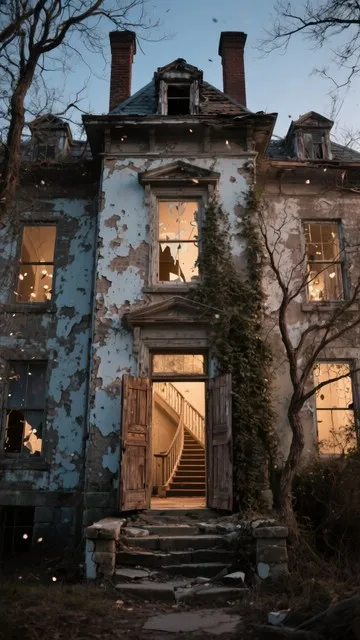
Photo: abandoned decaying Victorian mansion with broken windows at dusk, via images.stockcake.com
Consider what the average American book club is reading this season: not the thriller with the twist, not the memoir with the redemption, but a novel in which a family slowly rots inside a house that is eating them. Library hold lists for gothic fiction run months long. TikTok's book communities have elevated haunted-house fiction to a genre with its own celebrities. The mansion, it turns out, was not a phase.
The comfortable explanation is escapism — cozy spookiness, candles and sweater weather. The honest explanation is more uncomfortable: the decaying mansion has become the most accurate building in the American imagination.
A House That Lies About Its Condition
The gothic house has always been a machine for exposing what a family refuses to say. Its genius as a symbol is that it looks respectable from the street. The columns are still straight. The porch light still works. Only inside — behind the wallpaper, under the floorboards — does the rot announce itself.
This is, readers have noticed, simply a description of contemporary American institutional life. Infrastructure graded on a curve. Hospitals closing in towns that keep their flags up. Universities with billion-dollar endowments and graduate students on food stamps. The national condition is a fine facade wrapped around structural damage, and no genre has spent two centuries learning to narrate that specific arrangement quite like the gothic.
Why the Book Club Turned
The mainstreaming of gothic fiction among general readers — the demographic that once wanted uplifting endings and redemptive arcs — marks a genuine shift in what counts as pleasurable. Book clubs built for discussion have discovered that gothic novels are, structurally, discussion machines: every reader must decide what the house means, whether the haunting is supernatural or familial, whether the past can be paid off or only compounded.
There is also an economic reading that should not be avoided. Gothic fiction is a literature of inherited debt — of young protagonists discovering that the property they've been left comes with obligations they never signed. In a decade when homeownership has receded for most Americans under fifty, the fantasy of inheriting a house at all is already dark. Inheriting one that hates you is simply the honest version.
Against the Renovation Fantasy
American culture's default response to decay is the renovation show: buy the wreck, reveal the bones, flip the ending. Gothic revival fiction is the counter-programming, and its popularity among ordinary readers suggests a quiet refusal of that optimism. In these novels, the house cannot be fixed, because the house was never the problem. The problem is what was done to keep it standing — the labor, the exclusion, the buried costs — and the genre insists, with a formal patience no other tradition matches, that ledgers of that kind do not balance. They inherit.
That is a bleak thesis for a genre topping library waitlists. But readers are not choosing it because it is bleak. They are choosing it because, for the first time in a long while, the story on the page looks like the one outside the window — and someone, finally, is telling it without flinching.