The Unfilmable Void: Why Cosmic Horror Lives and Dies on the Printed Page
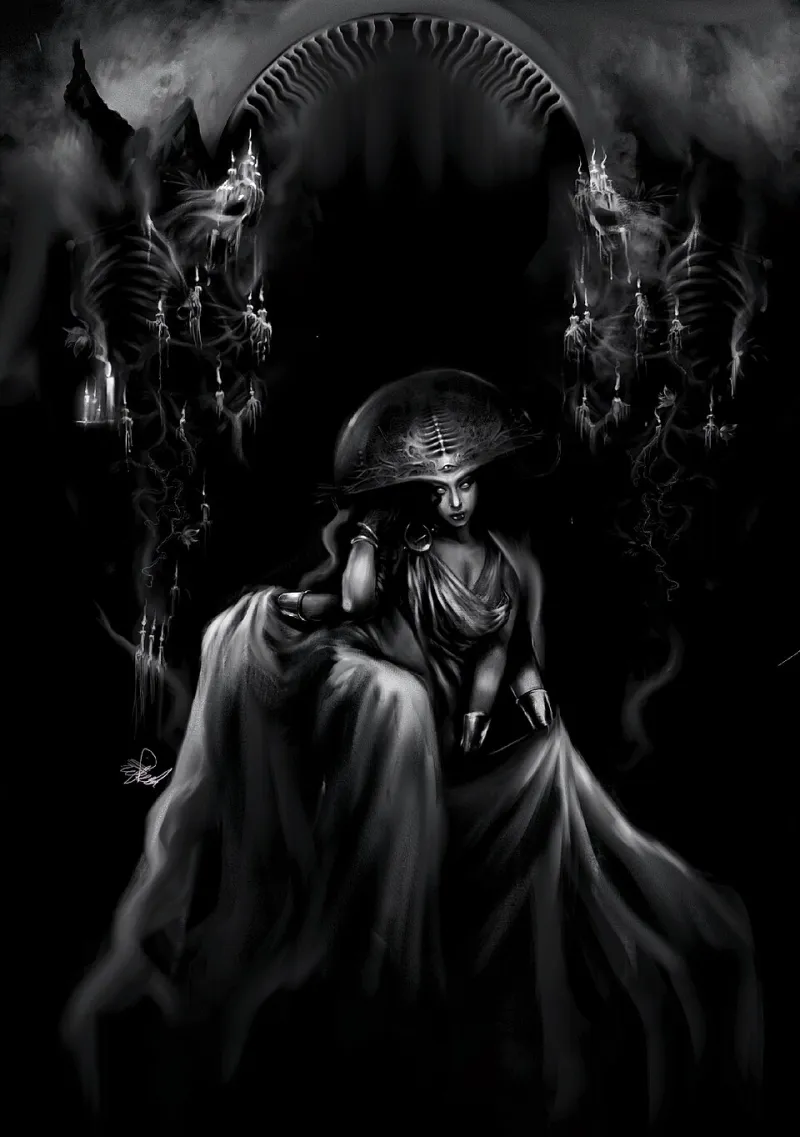
Photo: Zbzizi, CC BY 4.0, via Wikimedia Commons
Consider what a streaming platform must do to sell a horror property. It must generate a trailer. The trailer must show something. That something — a tentacle, a shadow, a face contorted by forces beyond comprehension — immediately becomes the thing, fixed and finite, occupying a specific number of pixels on a specific type of screen. The infinite is rendered in 4K resolution. The unknowable is given a production budget and a release date.
This is the fundamental problem with adapting cosmic horror, and it is a problem that no amount of cinematographic sophistication has yet managed to solve. The subgenre that H.P. Lovecraft codified in the early twentieth century — and that a growing community of independent American writers has dramatically expanded and refined since — is built on a premise that visual storytelling structurally cannot accommodate: that the most terrifying things are precisely those which cannot be perceived, described, or comprehended. The moment you show the horror, you have already betrayed it.
What the Genre Actually Requires
Cosmic horror is frequently mischaracterized, even by its admirers, as being primarily about monsters. This misreading is what sends adaptation after adaptation toward the same dead end — elaborate creature designs, CGI expenditure, prosthetics that communicate biological strangeness but not metaphysical dread. The Lovecraftian monster is not the point. It is, if anything, a concession to narrative necessity, a placeholder for something the prose is actually gesturing toward.
What cosmic horror requires, at its most essential, is the communication of a specific philosophical condition: the recognition that human consciousness is not equipped to process the actual nature of reality, and that the attempt to do so produces not enlightenment but annihilation. The protagonist of a cosmic horror narrative is not threatened by a creature in the conventional sense. They are threatened by comprehension itself. Their sanity — their ability to function within the framework of human meaning — is what gets destroyed.
This is an interior experience. It takes place within the architecture of a character's mind, in the gap between what they perceive and what they are capable of understanding. Prose can inhabit that gap directly. Film cannot enter it without immediately externalizing it, which is to say, without destroying it.
The Streaming Graveyard
The evidence is abundant and somewhat melancholy for fans of the genre. Adaptations of Lovecraft's own work have ranged from the earnest to the campy to the occasionally inspired but always ultimately compromised. More instructive, perhaps, are the adaptations of works that draw on the Lovecraftian tradition without direct attribution — the prestige streaming productions that arrive with considerable critical anticipation and depart having generated atmosphere without genuine dread.
The pattern is consistent. A production captures the aesthetic surface of cosmic horror — the fog, the isolated geography, the unsettling architecture — while being unable to reproduce its essential experience. Viewers are given beautiful, disturbing imagery. They are not given the sensation of their conceptual framework dissolving. The distinction matters enormously. One is an aesthetic experience. The other is an existential one. Film reliably produces the former. It has not yet found a method for producing the latter.
This is not a failure of craft. Some of these productions represent genuinely accomplished filmmaking. It is a failure of medium — or more precisely, a recognition that mediums have irreducible properties, and that some of those properties are definitionally incompatible with certain kinds of storytelling.
Independent Writers and the Structural Advantage
Here is where the story becomes interesting for American independent dark fiction. The very quality that makes cosmic horror resistant to adaptation — its dependence on the reader's imagination as the primary generator of terror — is precisely what makes it available to writers operating without Hollywood resources.
A novelist describing an entity that human language cannot adequately name does not need a visual effects budget. They need precision of suggestion, control of implication, and the discipline to stop describing before the image becomes concrete. These are writerly skills. They cost nothing except craft and attention. And they produce an effect that no amount of production expenditure can replicate, because the most frightening version of the unknowable is always the one the reader constructs from the materials the writer provides.
Independent dark fiction publishers have understood this advantage intuitively, even when they haven't articulated it in these terms. The small press ecosystem — chapbooks, digital-first imprints, subscription fiction platforms — has become a genuinely thriving space for cosmic horror precisely because the subgenre's requirements align so naturally with what independent literary publishing does well: prioritizing voice, precision, and formal control over spectacle.
Contemporary writers working in this space — many publishing through venues that operate entirely outside traditional New York distribution channels — have expanded the genre's philosophical range considerably beyond its Lovecraftian origins. They have interrogated the racial politics embedded in Lovecraft's original formulations, brought perspectives from communities whose relationship to cosmic insignificance carries very different historical weight, and developed formal innovations that the prose medium uniquely enables: second-person narration that implicates the reader directly, non-linear structures that enact cognitive dissolution rather than merely describing it, epistolary forms that allow the horror to accumulate across documents whose reliability is always in question.
What the Page Preserves
There is a specific reading experience that cosmic horror at its best produces — a gradual, creeping sense that the ground beneath the narrative is less stable than it initially appeared, that the framework of meaning the text has been constructing is quietly undermining itself. This experience requires time and interiority. It requires the reader to be alone with the text, building the world in their own mind, populating it with their own specific fears.
Streaming content, by its nature, is a shared experience. It is designed for communal viewing, for the social rituals of watch parties and real-time commentary. These are not conditions hospitable to the particular vulnerability that cosmic horror requires. Being genuinely frightened — not startled, not made anxious, but existentially destabilized — is a private experience. The best cosmic horror fiction creates a closed circuit between the text and the individual reader's imagination. Nothing interrupts it. Nothing mediates it. The writer's suggestion and the reader's elaboration are the only two elements in the room.
This is what independent dark fiction writers are protecting when they resist the flattery of adaptation interest. The unfilmable quality of their work is not a limitation. It is the mechanism of its power. The void cannot be rendered in pixels. It can only be opened in prose — and then left, carefully, for the reader to fall into.
The Market the Studios Cannot Touch
For independent publishers and the writers they champion, this represents something genuinely valuable: a corner of literary culture that is structurally insulated from the homogenizing pressure of adaptation economics. When a novel becomes primarily valuable as intellectual property — as the source material for a screen adaptation — the qualities that made it literarily significant are often the first casualties of development. Cosmic horror, by its nature, resists this process. It cannot be optioned into irrelevance.
The readers who seek it out understand, at some level, that what they are looking for cannot be found anywhere else. That understanding is the foundation of a loyal, intellectually serious readership — exactly the kind of audience that independent dark fiction publishing is built to serve.