The Glitch Is the Ghost: Why Human Imperfection Has Become Dark Fiction's Most Radical Act
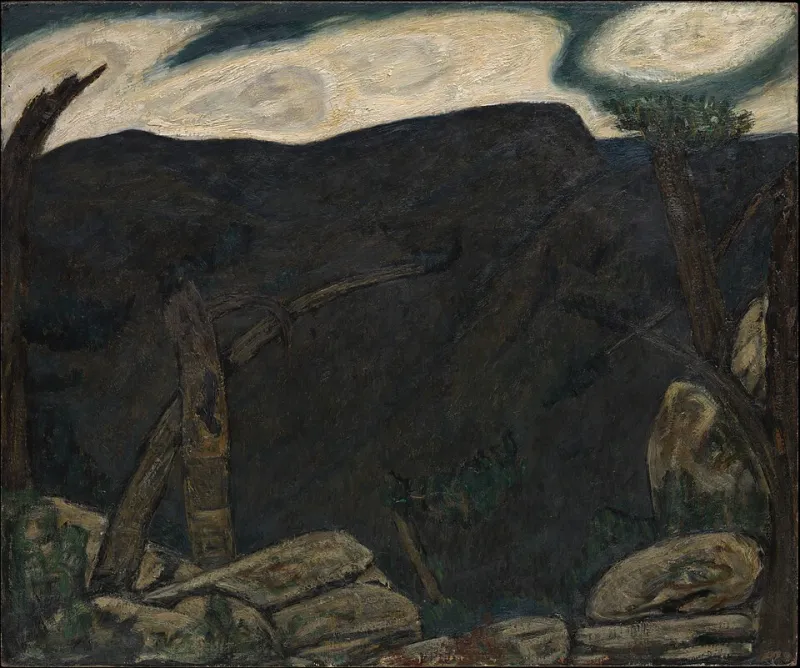
Photo: Marsden Hartley, CC0, via Wikimedia Commons
Somewhere in the past two years, a quiet crisis arrived at the desks of independent dark fiction writers across the United States. It didn't announce itself with a manifesto or a viral provocation. It arrived the way most real crises do — gradually, and then all at once — in the form of AI-generated stories that looked, at first glance, like literature.
They had structure. They had vocabulary. They deployed genre conventions with mechanical reliability. And they were, in some fundamental way that was difficult to articulate immediately, completely hollow.
The response from the independent literary community has been neither panic nor simple defiance. It has been something more interesting: a renewed, almost aggressive commitment to the qualities that make human writing genuinely threatening. The vulnerability. The contradiction. The places where the author's grip visibly slips.
The Texture of Genuine Fear
Ask any serious reader of dark fiction what separates the work that haunts them from the work that merely entertains, and the answers will converge on something that resists easy definition. There is a quality in the best literary horror — in Shirley Jackson's domestic dread, in Carmen Maria Machado's bodily unease, in the late Denis Johnson's spiritual vertigo — that feels like overhearing something you were not supposed to hear. It is the sensation of encountering a mind in genuine distress, working something out on the page in real time.
This quality cannot be prompted into existence. It is the residue of a specific human consciousness pressing against a specific experience of the world, and the pressure marks the prose in ways that are irregular, idiosyncratic, and non-reproducible.
AI systems generate text by identifying and replicating patterns. They are, in the most literal sense, the average of what has been written before. For genres where competent execution of convention is the primary goal, this creates a serviceable product. For dark fiction — a genre that derives its power from the friction between convention and rupture, between the expected and the genuinely strange — the average is precisely what fails.
Voices from the Independent Trenches
The authors navigating this moment in independent dark fiction are not, by and large, interested in positioning themselves as victims of technological displacement. They are interested in the question of what the moment reveals about their work.
"What the AI stuff clarified for me," says one independent horror author who publishes through a small press collective in the Pacific Northwest, "is that I had been smoothing things out in my drafts in ways that were actually making the work worse. I was self-editing toward a kind of professional finish that was removing the evidence of my actual thinking. The machines do that finish better than I can. So now I'm going in the other direction."
This sentiment surfaces repeatedly in conversations with indie authors who are currently producing some of the most formally adventurous dark fiction available to American readers. The response to algorithmic competence is not to compete on its terms but to abandon those terms entirely — to write toward the rough edge rather than away from it.
Another author, whose recent chapbook circulated through independent literary networks before finding a small-press home, describes her process in terms of deliberate exposure: "I started asking myself what I was most embarrassed to put on the page. Not in a confessional way, but structurally — what was I most afraid to let the story do? That's usually where the real horror is. Not in the monster. In the moment where my own hand shakes a little."
Authenticity as Formal Resistance
The independent publishing ecosystem has always been the space where formal experimentation and authentic voice survive pressure from commercial forces. Small presses, chapbook publishers, digital zines, and subscription-based literary platforms have historically absorbed writers whose work resists the smoothing operations of mainstream publishing. In the current moment, this infrastructure is taking on a new function: it is the space where human literary imperfection is not merely tolerated but actively cultivated.
This is not a romantic argument for rawness over craft. The authors doing the most interesting work in this space are not abandoning craft. They are redefining what craft means in a context where technical execution has been partially commodified. Craft, in this new formulation, is not the elimination of irregularity. It is the intelligent deployment of it — the understanding of which imperfections are structurally meaningful and which are simply noise.
The distinction matters enormously. A sentence that breaks its own grammar at the moment of greatest emotional pressure is doing something. A sentence that breaks its grammar because the author was careless is doing something else. The reader feels the difference, even when they cannot articulate it, because one kind of rupture carries intention and the other does not.
What Machines Cannot Metabolize
The philosophical crux of this moment is not really about technology. It is about what literature is for.
If the function of dark fiction is to efficiently deliver genre satisfactions — the well-placed scare, the competent atmosphere, the familiar arc of dread and release — then AI-generated content represents a genuine competitive challenge to human authors. It can do those things reliably and at scale.
But if the function of dark fiction is to transmit the experience of a specific consciousness confronting the darkest corners of human experience — to create, in the reader, a temporary but genuine expansion of what it feels like to be alive and afraid and uncertain — then the machine is not a competitor. It is a clarifying contrast.
The horror that lingers is the horror that feels true. And truth, in literature, is not accuracy. It is the sensation of encountering another mind that has been somewhere real and brought something back. That something is always marked by the journey. It is always, in some way, damaged.
Writing Into the Wound
Independent dark fiction in the United States is, at this particular moment, in a position of unusual cultural significance. While mainstream publishing navigates the commercial implications of generative AI with characteristic institutional caution, and while large platforms experiment with AI content in ways that flatten the literary landscape, the independent sector is doing something quietly radical.
It is writing into the wound.
The imperfection is not incidental. The contradiction is not a failure of logic. The moment where the author's voice shakes is not a defect in the manuscript. These are the signatures of genuine human experience pressing itself onto the page — the evidence that someone was here, that they felt something, that the feeling was complicated enough to resist clean resolution.
Algorithms do not leave signatures. They leave surfaces.
The readers who find their way to independent dark fiction — who seek out the chapbooks and the small-press collections and the digital publications that exist outside the algorithmic recommendation economy — are, increasingly, readers who understand the difference. They are not looking for a smooth surface. They are looking for a wound that has been made into something.